

Description
Precise dissolved oxygen measurement.
Hamilton’s VisiFerm optical dissolved oxygen sensors provide a significant advancement over traditional amperometric sensors, offering more robust measurements and minimal maintenance. Ideal for critical applications in biopharma and other hygienic industries, VisiFerm sensors eliminate issues like CO2 fouling and the need for electrolyte replacement. Process-related drift due to carbon dioxide and other acid gases is fully eliminated with optical technology. The VisiFerm family includes options like the VisiFerm mA and VisiFerm RS485-ECS, catering to various installation needs and communication protocols. Integrated intelligence with Arc technology enables features like reduced calibration frequency, enhanced diagnostics, and simplified troubleshooting. Explore our range of VisiFerm sensors, designed for reliable and accurate dissolved oxygen monitoring in your controlled environments. Hamilton also provides comprehensive support and resources, including our O2 Measurement Guide and a whitepaper on potential sources of optical dissolved oxygen measurement error and ways to mitigate their impact.
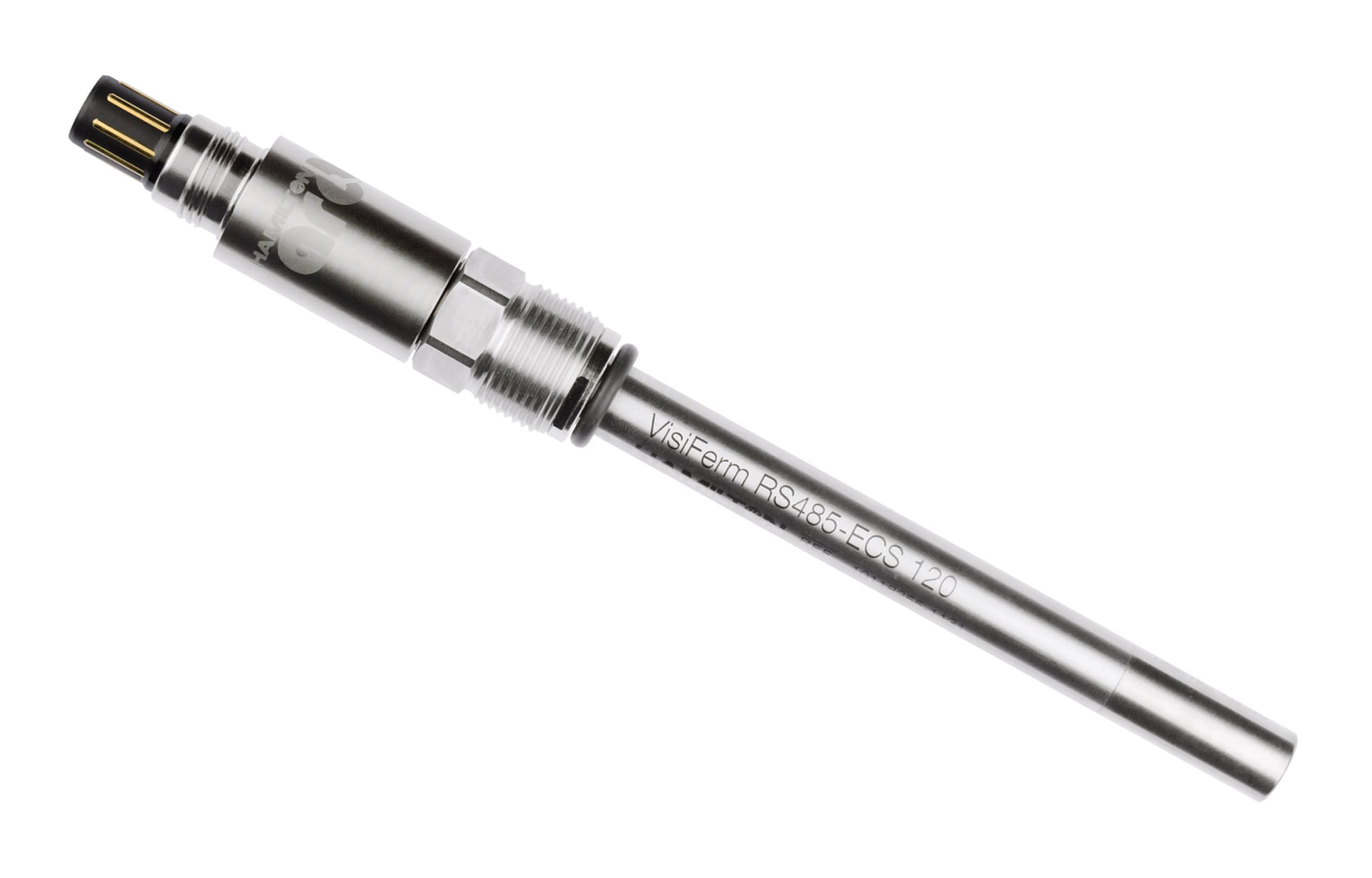
The VisiFerm RS485-ECS optical dissolved oxygen sensor has integrated opto-electronics for full measuring device functionality and self-diagnostics. This DO probe is ideal for rigorous biotechnology, biopharmaceutical, and food & beverage applications.
VisiFerm RS485-ECS Details
VisiFerm RS485-ECS dissolved oxygen sensors are a simple way to upgrade from traditional polarographic sensors as they communicate via Modbus, ECS, and 4-20 mA (via Arc Wi 2G Adapter). This optical DO probe directly connects to process control systems (PCS) without external transmitters.
Unlike conventional amperometric or electrochemical dissolved oxygen sensors, VisiFerm RS485-ECS offers flow independence, rapid startup with no polarization time, less maintenance, and no nA noise. Communication with the VisiFerm DO sensor and ArcAir software can be accomplished through Bluetooth wireless or a standard wired connection to a PC or laptop.
Specifications
|
a-length |
120mm, 160mm, 225mm, 325mm, 425 mm |
|
Electrical Connector |
VP8 |
|
Measurement Principle |
Oxygen dependent luminescence quenching, temperature compensation |
|
Measuring Range |
4 ppb to 25 ppm (DO) 0 to 62.85 %-vol or 0 to 300 %-sat |
|
Accuracy at 25 °C |
1 ± 0.05 %-vol: 21 ± 0.2 %-vol; 50 ± 0.5 %-vol |
|
Drift at Room Temperature |
< 1 % per week |
|
Sensor Cap |
ODO Cap H2 |
|
Electrolyte |
None |
|
Oxygen Consumption |
None |
|
Temperature Sensor |
NTC 22 kOhm |
|
Configurable Values |
DO: mbar; %-sat; %-vol; µg/l; mg/l; ppb/ppm (dissolved oxygen); Temperature: °C, °F, K |
|
Diameter |
12 mm |
|
Process Connection |
PG13,5 |
|
Analog Interface 1 |
ECS / 4 to 20 mA |
|
Digital Interface |
RS485 Modbus (max. 31 addresses) |
|
Operating Voltage |
7 to 30 VDC max. 1 W |
|
Serial Number |
Yes |
|
Response Time t98% |
< 60 s at 25 °C |
|
Autoclavable |
Yes, max. Temperature 130 °C |
|
CIP |
Yes |
|
Steam Sterilizable |
Yes, max. Temperature 140 °C |
|
Operating Temperature Range |
-10 to 140 °C; the sensor provides no DO reading above 85 °C |
|
Pressure Range bar g |
-1 to 12 bar |